
Richmond County 72-Hour Release Gap
Northern Neck Regional Jail, or NNRJ, is the regional jail serving Richmond County. Its official roster landing page covers people currently in custody. No official NNRJ view lets a reader select the last 72 hours, browse releases by date, or recover names removed during the prior three days. Richmond County Sheriff's Office also offers no verified rolling release feed or release-list mobile app.
The three-day problem is historical. A current match can prove that NNRJ reports someone in custody now, but it says nothing about who left on the two prior days. A missing name is just as limited. It can reflect community release, transfer, a hold-based handoff, a spelling mismatch, or update timing. Reconstruct the period from positive records instead of treating today’s roster as yesterday’s archive.
The manifest-captured roster page shows the current-only scope and warning. Consult the live NNRJ source for its latest wording.
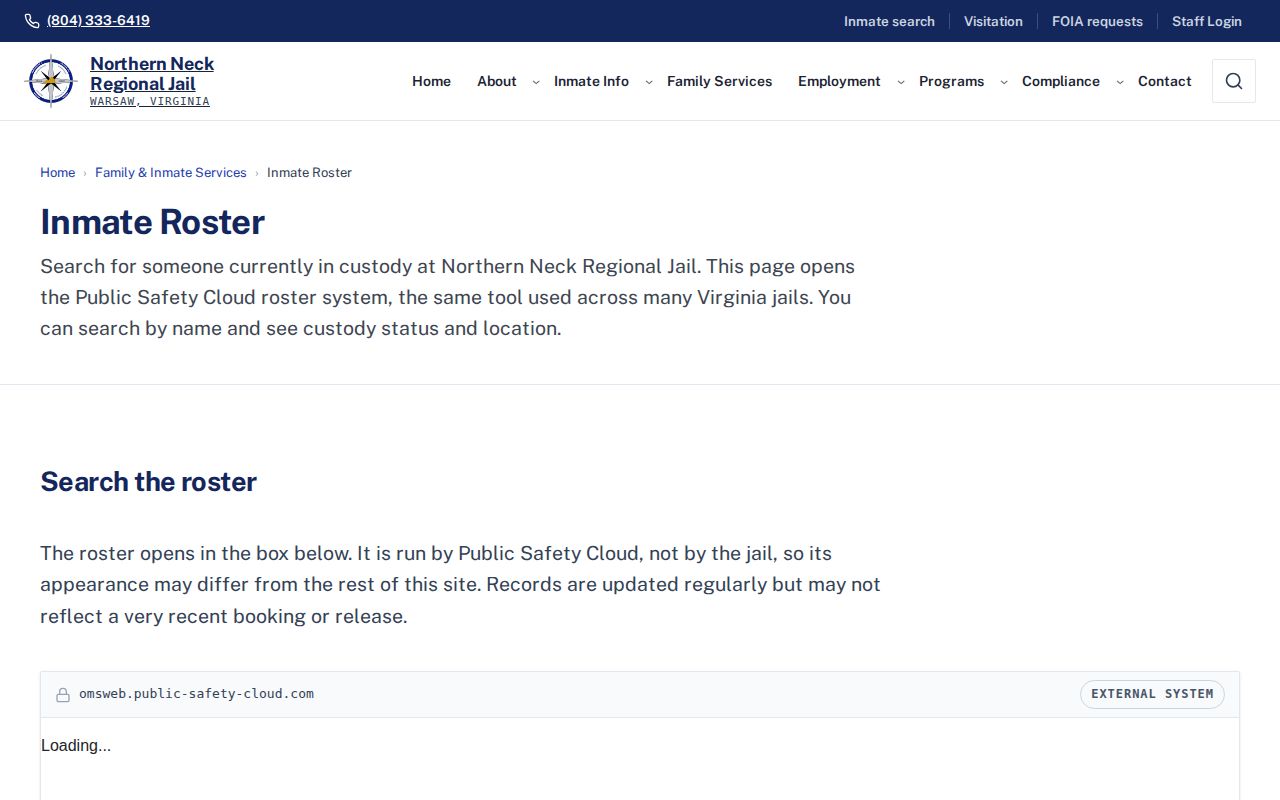
The screenshot supports a present-custody check, not a list of everyone released during a past three-day span.
Reconstruct Richmond County Releases
Define the period before searching. Write the start and end dates and note whether the range crosses a weekend or holiday. Then identify the person or booking at issue. NNRJ does not have to create a 72-hour list that it does not maintain, but its custodian can search for existing release or movement records described with reasonable detail.
- Search the NNRJ roster for present custody and record the date and time of the check.
- Search VINELink for the specific person and compare the reporting agency, identity details, and event type.
- Review Richmond County General District and Circuit Court history through OCIS for a bond, dismissal, sentence, transfer, or later order within the period.
- Send NNRJ a narrow request for the actual movement or release entry covering the named booking and date range.
- If the record names a destination, continue with VADOC, another jail, USMS, BOP, or ICE as appropriate.
A same-day question follows a different route. The Richmond County 24-Hour Release List process emphasizes NNRJ's day-of-release telephone confirmation and active processing. The three-day method relies more heavily on records that preserve the event after it has passed.
Note: A court order can explain authority for release, but the jail movement entry establishes when NNRJ carried it out.
Richmond County Three-Day Release Fields
No public 72-hour table displays these fields. They are the elements to seek in an existing NNRJ booking or movement record. Requesting them by name helps distinguish a community release from a transfer, which a mere roster disappearance cannot do.
| Record field | Three-day value |
|---|---|
| Name and identifying fields | Links the event to the intended person rather than a similar name. |
| Booking number | Separates one custody episode from an older or later booking. |
| Admission date and time | Sets the start of the NNRJ stay being researched. |
| Release or movement date and time | Places the event inside or outside the defined 72-hour range. |
| Release type or reason | May explain bond, time served, court order, or another release basis. |
| Destination or receiving agency | Shows whether custody ended locally but continued elsewhere. |
A booking photograph may be requested if maintained and releasable, but it is not proof of release. The official roster page does not promise a photo field. Ask the NNRJ custodian to confirm what exists rather than importing fields from a commercial listing.
Richmond County Weekend Release Records
A three-day window often spans a weekend, but NNRJ publishes no special weekend or holiday release schedule. Do not assume the jail releases at a fixed hour or holds every court-ordered release until a business day. Official guidance states that release follows receipt of court paperwork and internal processing. The result may be recorded after the order's timestamp and before another system refreshes.
Office access matters when the event is reviewed later. NNRJ FOIA requests receive the Virginia working-day response framework, and account-balance pickup is limited to business hours. Those administrative details do not change the release date. They explain why a person may have left while a related request, property issue, or account task remains pending.
For a weekend range, list each calendar date in the request and ask for existing release or movement entries. Do not ask the jail to calculate “the last 72 hours” without an anchor time. A fixed start and end prevents disputes over whether the period rolls from the present minute or covers three calendar days.
Request Richmond County Release History
NNRJ’s FOIA and Information Requests page lists Amy Dameron as the FOIA officer. Send email to adameron@nnrj.state.va.us, mail to FOIA Officer, P.O. Box 1090, Warsaw, VA 22572, visit 3908 Richmond Road during office hours, or call (804) 333-6016 for records routing. Include the full name, identifying detail, booking number if known, and exact date range.
Virginia FOIA generally requires action within five working days. NNRJ may invoke seven more working days with a written explanation. A response can produce records, provide some parts while citing authority for withheld parts, report that no record was found, or use the extension. Costs reflect actual copying and staff search or preparation work. No fixed photo or release-report fee is posted.
Ask for a cost estimate and set a limit before work begins. A focused wording could request the booking sheet and custody movement entry showing actual release or transfer date, time, reason, and destination for one person during the stated span. The agency need not create a new 72-hour report when no such report exists.
Note: A narrow request is more likely to locate the right custody event and can reduce unnecessary search time.
Richmond County Release Data Sequence
NNRJ warns that its current roster can lag a very recent booking or release and does not publish an exact refresh cadence. Over three days, that uncertainty compounds. A name seen Monday and absent Wednesday does not identify whether the event occurred Monday night, Tuesday, or Wednesday. Nor does it reveal whether the outcome was bond, sentence completion, or transfer.
Compare timestamps from each system. A court order may come first. NNRJ then receives the paperwork, checks for other authority, processes the departure, and records the movement. VINE may post an event tied to the reporting jail. A receiving agency can update later. Preserve the sequence when records differ instead of choosing one system and discarding the rest.
- Release
- Departure from the named custodian, which may or may not be a return to the community.
- Transfer
- A movement in which custody continues with another facility or authority.
- Disposition
- The court's outcome or ruling in a case, not the jail's exact exit timestamp.
- Detainer
- A request or authority that can cause a handoff after one agency ends its custody.
Richmond County Release System Boundaries
The NNRJ route applies to a local or regional jail detainee. Haynesville Correctional Center is a VADOC state prison located in Richmond County. A person leaving Haynesville belongs in the VADOC locator, executed release documents, NAAVI notices when applicable, and later Parole Board records. NNRJ's three-day question does not cover that state release merely because the prison shares the county.
Federal legal custody creates another split. A federal pretrial detainee may be housed at NNRJ under USMS arrangements. Leaving the NNRJ roster can reflect transfer to another contract jail or delivery to BOP, not release to the community. Check the federal docket, NNRJ movement entry, USMS, and BOP based on the stage.
ICE offers a distinct 60-day recent-release window in its detainee locator, but only for immigration custody. It is not a Richmond County jail archive. Keep each result tied to the agency that created it.
Verify Richmond County Three-Day Releases
The strongest reconstruction joins an NNRJ movement record with the court disposition and, when timely, a VINE event. If the record shows transfer, the next custodian must confirm what happened later. If the person is fully absent from current tools, the focused historical request becomes more important, not less.
Keep each result in chronological order. Record the agency, event label, and source time, then note any destination. A release from NNRJ followed by VADOC intake is a local exit and continued state custody. A VINE transfer followed by no public receiving entry remains unresolved until the jail or receiving authority confirms the handoff.
For a broader search by one name, use the Richmond County released inmate records path. For a three-day list question, avoid copying current roster names into a private archive. NNRJ is the source that can confirm whether existing agency records support the requested span.
Note: Use wording such as “released from NNRJ” until every relevant transfer or hold has been resolved.