
Richmond County VINELink Coverage
Virginia’s notification system has a firm custody boundary. Virginia Jail VINE, reached through VINELink, is the relevant service for a person held by a participating local or regional jail such as Northern Neck Regional Jail. NNRJ is the normal local custody starting point for Richmond County. The Richmond County Sheriff makes arrests and handles law-enforcement duties, but the Sheriff is not the jail operator and is not the first custodian for an NNRJ release event.
VINELink is a specific-person status and notification channel, not a permanent released-inmate archive. A local release or out-of-custody event means the person left the reporting jail’s custody. It may reflect community release, transfer to VADOC, movement to another jail, or a handoff to a federal or other authority. The event alone does not distinguish all of those outcomes.
Haynesville Correctional Center follows a different path. VADOC state-prison notifications use NAAVI through VADOC Victim Services. A local VINE registration does not move with a person into VADOC. BOP, USMS, and ICE custody also require their own federal systems. Keeping the reporting agency in view is the key to reading any Richmond County release alert.
Search One Richmond VINELink Record
Open VINELink, select Virginia, and choose the offender or custody search offered by the service. Search for the person by name or by an identifier when the interface offers one. A name is only a lead. Compare the reporting agency and every identity detail shown before opening or registering on the record, especially when two people have similar names.
For a Richmond County jail detainee, the expected agency is Northern Neck Regional Jail. If the record instead points to another Virginia jail, confirm whether the person transferred or whether the match belongs to someone else. If NNRJ still lists the person in its current roster, the released-person question remains open. A VINE event and the jail record should be read in timestamp order.
- Go to VINELink and select Virginia rather than a similarly named locality in another state.
- Choose the offender or custody search and enter the exact name or available identifier.
- Compare the agency, status, facility, and identity details with the known Richmond County case.
- Open only the matching record and read the current custody status and event language.
- If no reliable result appears, check NNRJ, the court case, and the next possible custodian.
- Save the agency name and event time so a later transfer can be traced in sequence.
The VINELink Virginia selection and person-search screen is shown below.
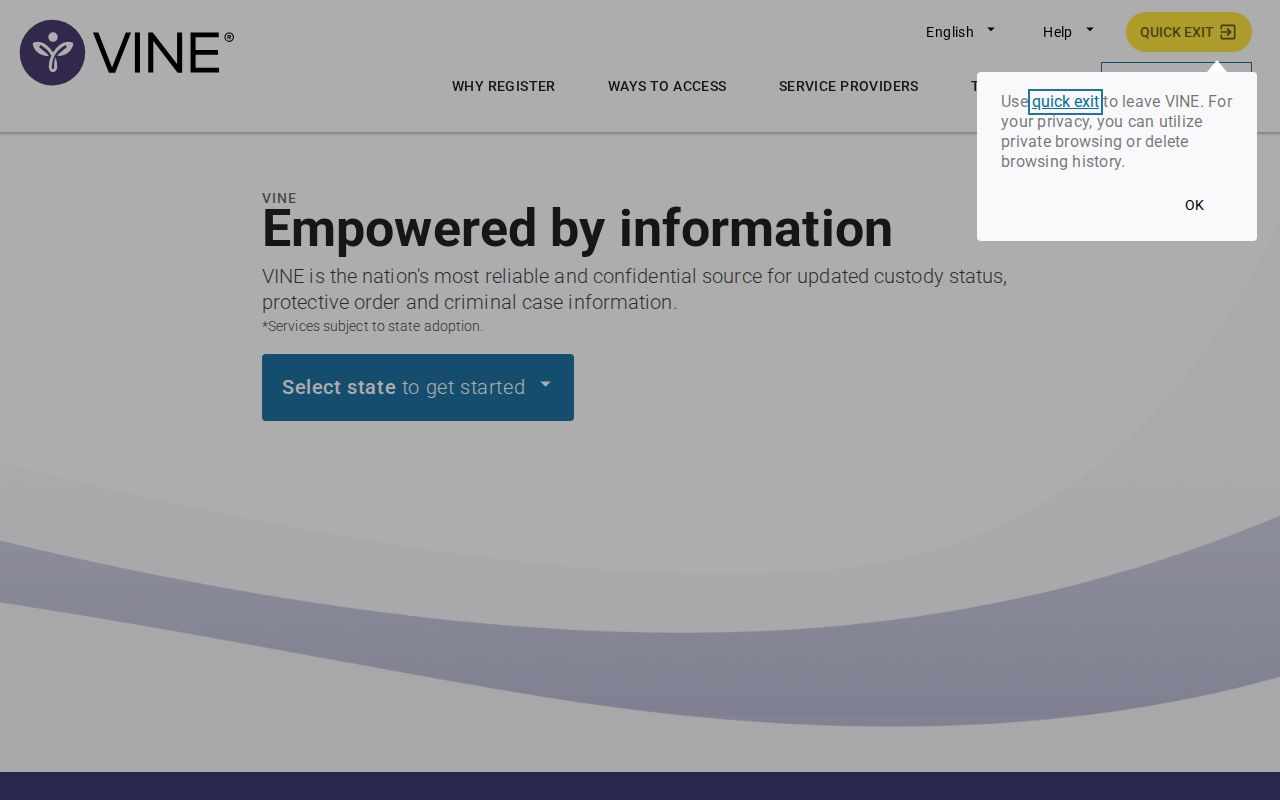
The state and agency choices on that screen keep an NNRJ search tied to the custodian that reports the event.
Note: A missing VINELink match is inconclusive because spelling, identity, participation, timing, or a custody transfer can affect the result.
Richmond VINELink Release Record Fields
The exact fields depend on what the participating agency supplies. Virginia’s documented workflow supports a specific-person custody record, reporting facility or agency, custody status, and event notices. Do not add a release date or field that the open record does not display. A person’s name without the right agency and identity match is not enough.
| VINELink item | What it establishes | What it does not establish |
|---|---|---|
| Name or offered identifier | Helps locate a candidate record | Does not resolve identity by itself |
| Agency or facility | Identifies the jail reporting the custody event | Does not identify every later custodian |
| Custody status | States the status supplied by the reporting agency | Does not guarantee real-time data |
| Release or out-of-custody event | Confirms exit from the reporting jail when matched correctly | Does not distinguish community release from every transfer or hold |
| Transfer event | Signals that custody moved from the reporting facility | Does not complete the receiving-agency search |
| Alert registration | Connects a notice method to the selected record | Does not automatically migrate after a transfer |
A Virginia Jail VINE notice can concern release, transfer, death, or escape and return, with some additional events depending on the facility. Those terms are not interchangeable. Transfer means custody continued. An escape event is not an authorized release. Death ends custody but is not return to the community. Read the named event before describing the outcome.
Register Richmond County Release Alerts
Registration begins on the correctly matched record. Virginia VINE can also be reached by phone at 1-800-467-4943 or by TTY at 1-866-847-1298. Depending on what the service offers for that record, notices may use telephone, text, email, TTY, or an app. Enter the destination carefully. Telephone registration requires a PIN, which confirms that the automated call reached the intended recipient.
The PIN has a practical role. When an automated telephone notice arrives, enter it to confirm receipt and stop repeat calls. A notice that is missed or not confirmed may repeat. Keep the PIN available but do not place it in a public note. If custody later moves, register again with the new system because the local registration will not follow the person automatically.
- Open the correct Richmond County custody record or call the Virginia VINE line.
- Select notification registration and choose a method currently offered for that record.
- Enter the phone number, email address, TTY destination, or app registration information.
- Create a PIN when registering for automated telephone notices.
- Enter the PIN when the call arrives to confirm receipt and stop repeated calls.
- After a transfer, identify the new custodian and register in its applicable notification system.
Registration should happen before an expected event when possible. A day-of-release search can still help, but NNRJ warns that very recent booking or release activity may lag in its public roster. An alert is one part of the evidence chain, not a substitute for jail confirmation or a release/movement record.
Note: Save the agency name with the alert because “released” is meaningful only in relation to the custodian that reported it.
Richmond VINE to NAAVI Handoff
A transfer from NNRJ to VADOC ends the usefulness of the local registration for later state-prison events. Virginia’s official workflow says local-jail VINE and VADOC NAAVI are separate. Eligible victims must register with VADOC Victim Services for state-prison notices rather than assume VINELink will continue to report the person after intake.
NAAVI uses two release terms that should remain distinct. Anticipated Release is normally sent about thirty days before an expected date. Actual Release states that VADOC custody ended. The anticipated event is a forecast and can change. Even an Actual Release notice does not rule out a detainer or handoff to another authority. The executed VADOC release record should state the relevant departure and destination where releasable.
VADOC Victim Services can provide notification assistance at 1-800-560-4292 or (804) 674-3243, by email at victimservices@vadoc.virginia.gov, on weekdays from 8:30 a.m. to 5:00 p.m. The official VADOC notifications page is the source for this state-prison path.
The VADOC notification screen is shown below with the anticipated and actual release distinction.
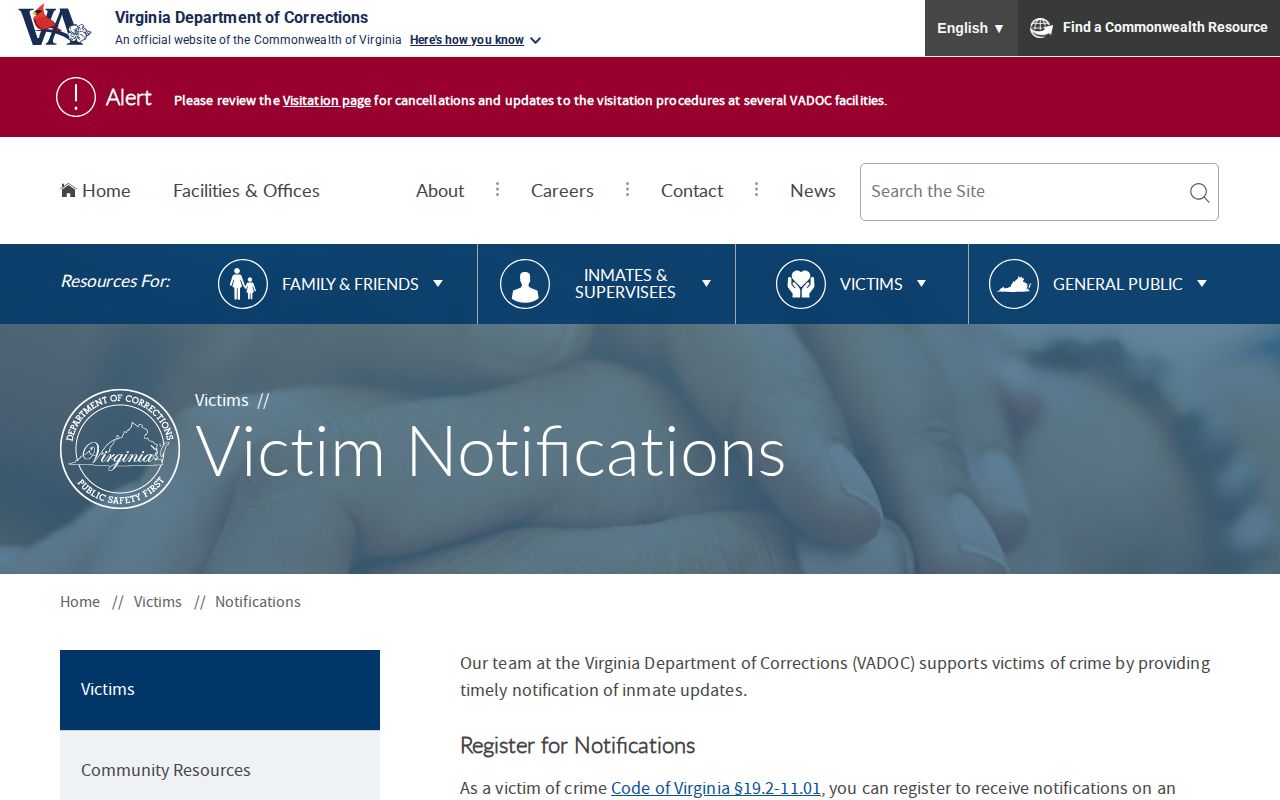
The state service begins where the local NNRJ VINE record ends, so a transfer requires a fresh registration.
Confirm Richmond County VINELink Results
A positive, well-matched event is stronger than a disappearance. If VINELink reports release from NNRJ, compare the time with the NNRJ roster and status route and the Richmond County court disposition. Ask whether the person was released to the community, transferred, or remained in processing. NNRJ’s current roster is not an archive, and its missing name cannot answer that question on its own.
If the court imposed a state sentence, search the VADOC locator. A prison location indicates state custody; a probation or parole district can support community supervision. If a federal detainee left NNRJ, check the federal court and USMS route, then the BOP locator when the person entered BOP custody. VINELink does not cover BOP status. ICE also has a separate locator.
NNRJ publishes two useful phone routes. The general number, (804) 333-6419, can route a status question. For a person expected to leave that day, the family-services page gives (804) 250-1750. Ask whether court papers were received and whether the event was release or transfer. Staff may limit disclosure, so a narrow NNRJ FOIA request for the movement entry remains the best historical path when a VINE event is unavailable.
For historical proof, request the NNRJ release or movement entry with the date, time, release type, and destination. The court order explains the legal basis, but the jail record documents the operational movement. The full Richmond County release-record search path puts these sources in order without treating one system as universal.
Richmond Release Systems by Custody
The right final check follows legal custody, not just the building where a person was last seen. NNRJ can house a local detainee and, under some arrangements, a federal detainee. Haynesville is a state prison in Richmond County, but its records remain VADOC records. Those people can be in the same county while requiring different notification tools.
| Custody path | Notification or status source | Best release confirmation |
|---|---|---|
| NNRJ local or regional jail | Virginia Jail VINE through VINELink | NNRJ movement/release entry plus court disposition |
| Haynesville or other VADOC prison | NAAVI/VADOC Victim Services | Executed VADOC release documents and current status |
| Federal pretrial custody | Federal court, holding jail, and USMS channels | Court order and custodian movement record |
| Sentenced BOP custody | BOP Inmate Locator | BOP release status and documentary record |
| ICE custody | ICE Online Detainee Locator | ICE status or case record within the relevant window |
“Released from NNRJ” should stay that narrow unless the receiving-system checks show more. The same rule applies to VADOC and BOP. Each official record proves the end of custody for the agency that created it.