
Richmond Projected Versus Actual Release
A projected or anticipated date is a forecast made from the sentence and the information then available. Actual release is an event carried out by the jail or prison. The two can match, but they are not the same record. Northern Neck Regional Jail must receive the court paperwork and finish processing before a local detainee leaves. VADOC says a state-prison release is completed by 11:59 p.m. on the release date, weather permitting, and uses signed release or supervision documents.
Pretrial custody does not have a sentence-computation date. The person may leave after a court sets and satisfies bond, after a release order, or after another legal change, but the time depends on the court and jail process. A sentenced inmate has an active term that the proper authority computes. For a local term, NNRJ’s jailer maintains the custody and earned-credit record. For a state-responsible term, VADOC performs the qualifying calculation.
The strongest confirmation names the agency and event: NNRJ released or transferred the person at a stated time, or VADOC executed release on a stated date. Avoid turning either record into a claim about every other possible hold.
Find a Richmond Projected Release Date
Start by identifying whether the person is an NNRJ detainee, a Haynesville state prisoner, or someone held under another authority. A Richmond County arrest does not by itself place the person in VADOC. Likewise, the physical location of Haynesville Correctional Center in Richmond County does not make NNRJ or the Sheriff responsible for the state sentence calculation.
The VADOC Inmate & Supervisee Locator is the first state search. It accepts the first three letters of the first name plus the full last name, or a seven-digit DOC ID. Location, race, gender, and age range are optional filters. VADOC says the locator is updated daily, yet it may contain errors or old information. Most important, its public landing page does not document a result field named “Projected Release Date.” Do not assume that exact label appears. Use only a release-date label actually displayed in a lawful matched result.
- Identify the legal custodian and whether the person is pretrial, locally sentenced, or state-responsible.
- For VADOC custody, search by the seven-digit DOC ID or a careful name match and complete the disclaimer and CAPTCHA.
- Read only the date and status labels the matched result actually displays; do not add a projected-date field.
- For an NNRJ sentence, ask the jail records route for the active term, jail credit, earned-credit record, and current calculation.
- Review the sentencing order and later court entries for consecutive terms, amendments, revocations, or other changes.
- Confirm departure through the executed NNRJ or VADOC release record rather than the earlier forecast.
The official VADOC locator landing page is shown below with its documented search inputs.
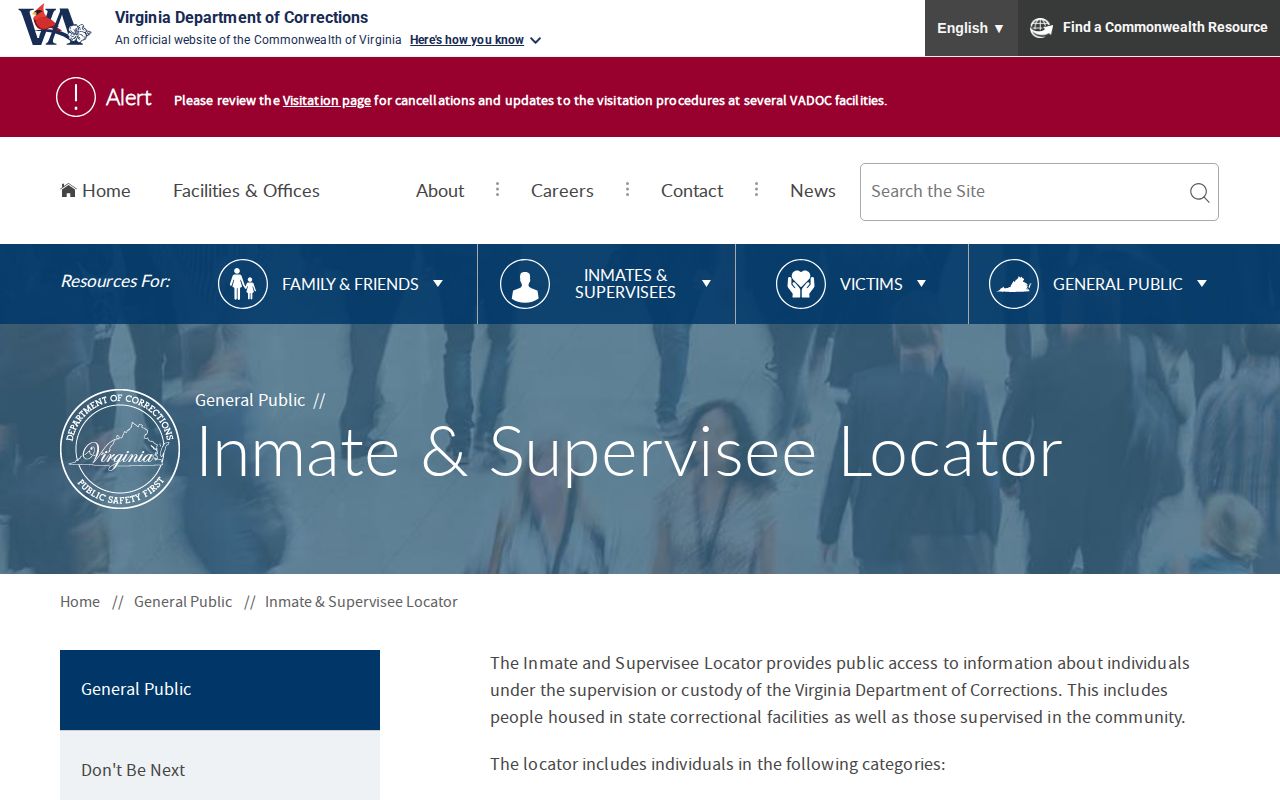
The screenshot supports the search method, not an undocumented projected-release label in a live result.
Note: A missing VADOC result is not proof of release because the locator is not advertised as a permanent archive of fully discharged people.
Richmond Earned Credit Framework
Virginia uses different credit systems based on offense date and sentence type. VADOC identifies Good Conduct Allowance, or GCA, for felony offenses before January 1, 1995 and misdemeanor offenses before July 1, 2008. For qualifying parole-eligible GCA terms over twelve months, VADOC calculates discretionary parole eligibility, mandatory parole release, and good-time release dates. GCA classes can range from zero to thirty days of allowance per thirty days served.
For felonies committed on or after January 1, 1995, Earned Sentence Credits, or ESC, generally apply along with parole ineligibility subject to statutory exceptions. Virginia Code § 53.1-202.2 defines one earned credit as one day deducted from incarceration. The current rate statute, § 53.1-202.3, caps listed subsection A offenses at 4.5 days per thirty served. Other qualifying subsection B offenses use levels of fifteen, 7.5, 3.5, or zero days per thirty served. Classification is reviewed at least once each year.
Credits do not rewrite a mandatory minimum, and they cannot cut the time that must pass before parole eligibility. The earning rate can depend on offense classification and conduct. The full statute, not a short online percentage, controls the possible rate. VADOC’s time-computation record is the place to see how those rules were applied to one sentence.
VADOC’s sentence time-computation page is shown below.
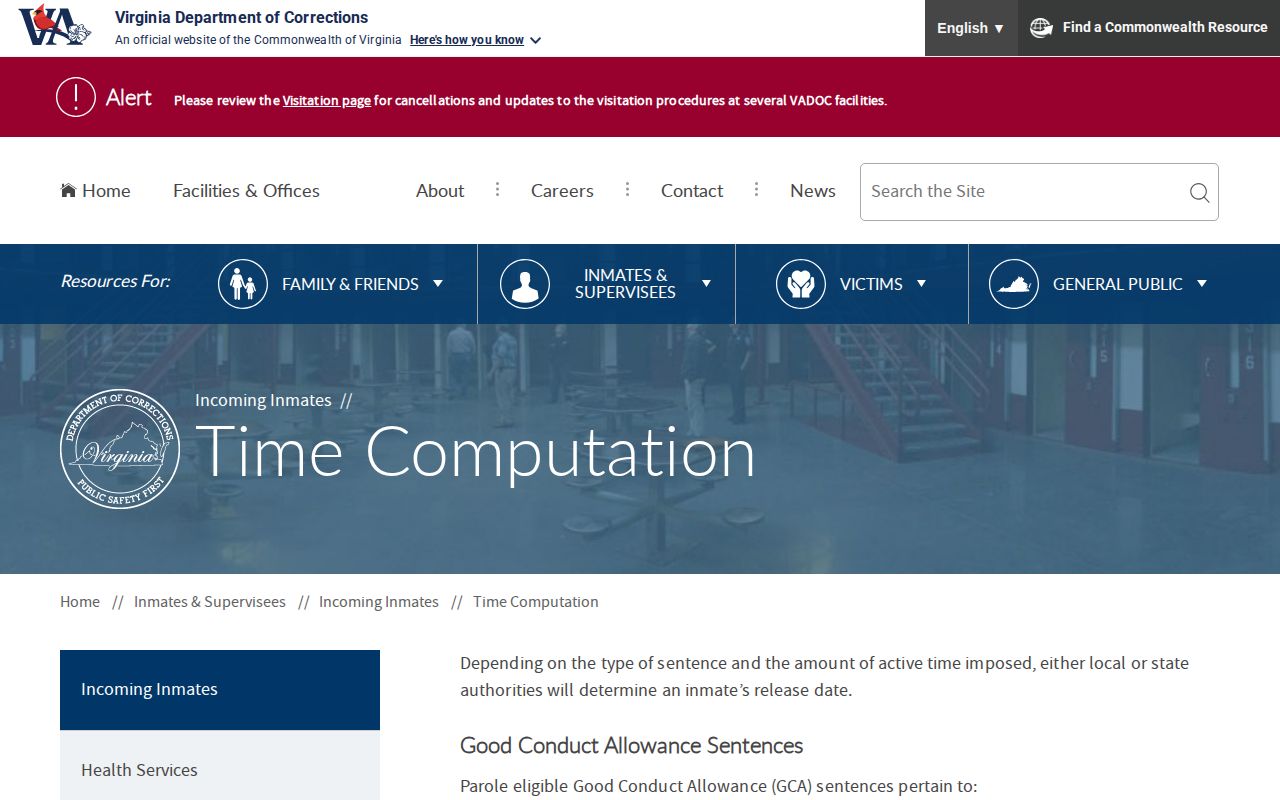
The state guidance separates credit categories and computation inputs rather than offering one universal Richmond County release formula.
Note: Earned credit shortens qualifying incarceration time; it does not prove the actual date or time a custodian completed release.
No Universal Richmond 85 Percent Rule
The familiar “serve eighty-five percent” phrase is not a reliable Virginia calculator. At the ESC-1 maximum, thirty served days plus 4.5 credit days satisfy 34.5 sentence days. That isolated ratio means about 86.96 percent of the nominal term is physically served, not exactly eighty-five percent. ESC-2 Level I can provide fifteen credit days per thirty served, while lower levels provide less or none.
Even the correct rate cannot produce a trustworthy date without the full sentence record. Offense group, conviction date, mandatory minimums, concurrent or consecutive terms, jail credit before sentencing, earning level, disciplinary history, parole rules, and legal classification can each alter the outcome. A quick percentage also cannot show a later detainer or new court order.
Local jail time adds another layer. Virginia Code § 53.1-116 requires the jailer to keep the committed person’s confinement terms, receipt date, reason, and written earned-credit policy. For a misdemeanor term of twelve months or less without a mandatory minimum, it permits one good-conduct credit day for one served day without a violation, including qualifying pre-conviction time, plus five days per thirty for specified activities when available. NNRJ’s actual policy and record must be requested. Another jail’s practice cannot be imported.
Why Richmond Release Dates Change
A release forecast can move when the authority receives new facts or applies a rule already built into the sentence. Some changes reduce the time. Others add time or prevent a planned community release. Compare the date on each official record and retain the older version so the sequence remains clear.
| Factor | Possible effect on the projected date | Best source |
|---|---|---|
| Pre-sentence jail credit | Credits qualifying time already spent in custody | Sentencing and time-computation record |
| Earning level or classification | Changes the rate of qualifying ESC accumulation | VADOC computation and classification record |
| Disciplinary violation | Can forfeit accrued GCA or ESC | Custodian discipline and time-computation record |
| Concurrent or consecutive sentence | Changes how multiple terms combine | Court orders and computed sentence structure |
| Mandatory minimum | Limits the part of a term that credit can reduce | Statute, conviction, and sentencing order |
| Detainer or hold | Can turn release from one agency into a transfer | Release/movement record and receiving agency |
| Parole decision | A grant can authorize later release; denial or deferral leaves custody in place | Parole Board report and VADOC execution record |
Virginia Code § 53.1-189 permits credit forfeiture for rule violations. Escape or attempted escape can forfeit accrued GCA and ESC, and only the VADOC Director may restore forfeited credits. This is one reason yesterday’s calculation may not match today’s official date.
Note: A transfer date may end one agency’s custody without changing the total time still owed to another custodian.
Richmond Parole Dates Are Milestones
Parole eligibility, a Board grant, prison release, and final supervision discharge are four different milestones. Section 53.1-151 sets eligibility thresholds for qualifying older sentences, while § 53.1-165.1 generally abolished parole for felonies committed on or after January 1, 1995 and now contains exceptions. Eligibility must be assessed from the current law and case facts.
A grant is not a release timestamp. Virginia law ordinarily requires VADOC to set actual release no sooner than thirty business days after notice of a discretionary-parole or conditional-release grant, with a narrow imminent-death exception. VADOC then executes release and conditions. Much later, a Parole Board annual discharge report can document the end of supervision through its supervision-discharge date.
Therefore, a Richmond County projected release date should not be substituted for a parole grant date, and neither date should be substituted for final discharge. State custody, community supervision, and completed supervision are distinct statuses.
Confirm Richmond County Actual Release
For NNRJ, use its family and release services guidance and call the day-of-release line at (804) 250-1750. Ask whether court paperwork arrived, processing ended, and the event was release or transfer. Staff cannot promise a fixed time. A focused NNRJ records request can seek the actual release or movement date and time, release type, and destination. The court order explains why release was authorized, but the jail record shows when it was carried out.
For VADOC, the executed documents are stronger than a forecast. The official process uses a notification-of-release letter and, as applicable, an Order of Release, Conditions of Probation, or Conditions of Parole signed and dated by the person and a witness. VADOC’s facility-release page describes that execution step.
The VADOC release-document screen is shown below.
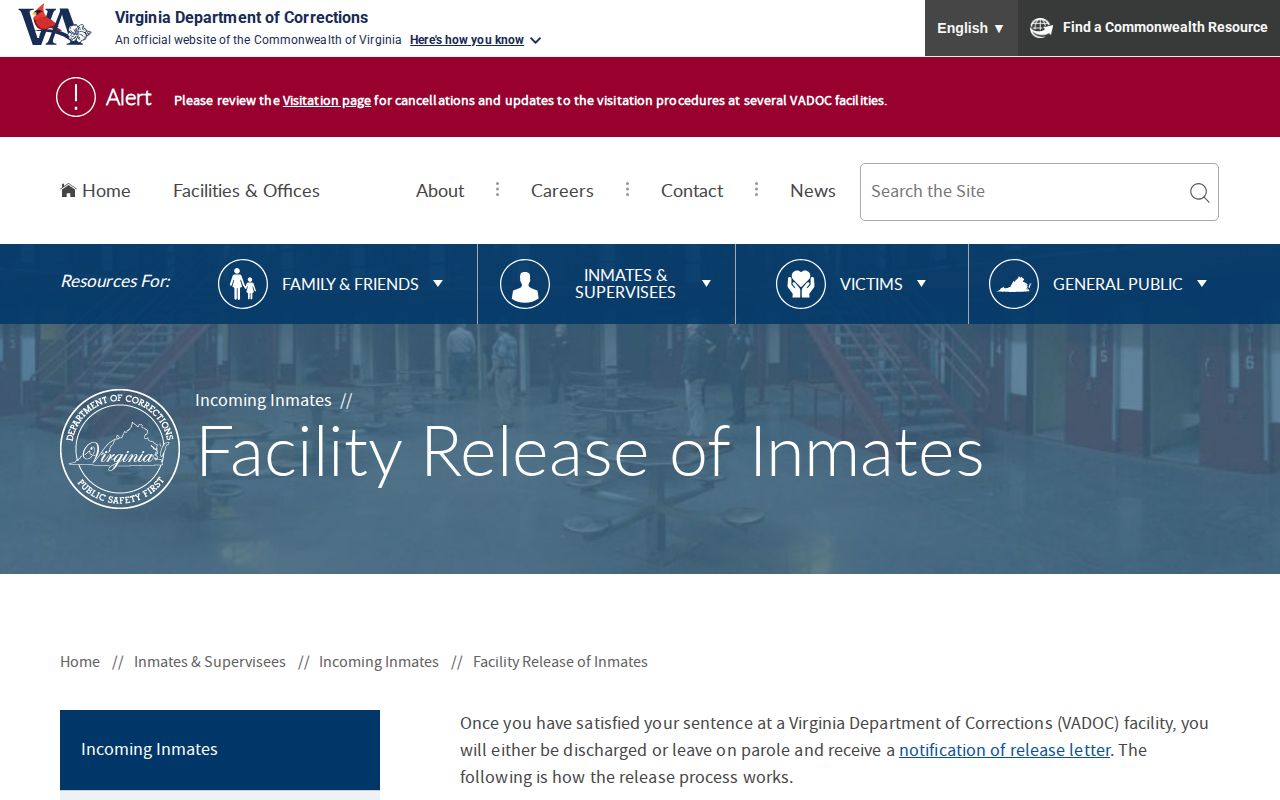
The signed and dated release papers establish the later event that a projected calculation could only forecast.
Virginia Jail VINE can add a local custody event, while NAAVI can give eligible victims anticipated and actual VADOC notices. A Richmond County Circuit Court order can explain a felony sentence or later change without proving the minute of departure. Registration steps are covered in the Richmond County VINELink check. For the full records chain across NNRJ, court, state, and federal sources, use the Richmond County released-inmate lookup.