
Haynesville Unit #17 Closure Records
Haynesville Correctional Unit #17 was a separate VADOC minimum-security unit on the Haynesville complex in Richmond County. The agency closed it effective June 30 and July 1, 2024. VADOC cited staffing, safety, maintenance, and operational factors across the announced closures. A search result that says the unit closed describes an institution, not an individual release event.
VADOC expressly stated that affected prisoners were relocated to other state facilities based on their security levels and classifications. Relocation is continued custody. The closure date should never be copied into an inmate record as a release date without that person's executed VADOC paperwork. The first task is to find the new institution, community-supervision placement, or later discharge evidence.
Search Haynesville Unit #17 Transfers
The VADOC Inmate and Supervisee Locator is the official public starting point for a person once associated with Unit #17. Search by the first three letters of the first name and full surname, or use the seven-digit DOC ID. Optional location, race, gender, and age-range filters can help distinguish similar names. Accept the disclaimer and complete CAPTCHA to reach results.
- Preserve the historical Unit #17 source, its date, and any DOC ID before starting a new search.
- Search VADOC by DOC ID when possible. A number is more stable than a facility name.
- Read a prison location as current custody and a probation or parole district as current community supervision.
- If no public result appears, do not infer release. The locator is not advertised as a full archive of people who completed all supervision.
- Ask VADOC for releasable facility history that connects Unit #17 to a receiving institution.
- Use executed release documents for any later claim that VADOC custody actually ended.
The locator updates daily, but VADOC warns that information may be inaccurate or outdated. Compare the result with release documents, court information, or another contemporaneous custody record before reaching a conclusion.
Haynesville Unit #17 Record Chain
A complete historical chain has several possible stages: Unit #17 custody, transfer to another VADOC prison, a calculated release date, execution of release or parole papers, community supervision, and final discharge. Not every person follows every stage. Each stage has its own record and date.
| Record | Question answered | Limit |
|---|---|---|
| Unit #17 facility history | Was the person assigned there? | Does not prove how custody ended |
| Receiving facility entry | Where did VADOC move the person? | Shows continued state custody |
| Release date calculation | When was departure expected? | Can change before execution |
| Signed release documents | When did VADOC carry out release? | Another detainer may still apply |
| Supervision district | Was the person in the community under VADOC? | Not final sentence discharge |
| Parole discharge report | When did Board supervision end? | Later than prison release |
This sequence prevents a move from being mislabeled as release. It also preserves the distinction between leaving a particular building and leaving VADOC legal custody.
Note: A facility transfer ends placement at Unit #17 but does not end the underlying VADOC sentence.
Request Haynesville Unit #17 History
VADOC is the custodian for state-prison assignment and release records. A focused inquiry should name Haynesville Correctional Unit #17, give approximate confinement dates, and include the seven-digit DOC ID when known. Ask for releasable facility-assignment history, transfer destination, actual release date or status, and the specific release document needed. Avoid demanding a custom report the agency does not maintain.
VADOC inmate and supervisee records may be confidential except as law authorizes disclosure. Privacy limits or subject consent can affect the response. The central contact shown on VADOC pages is P.O. Box 26963, Richmond, Virginia 23261; (804) 674-3000; docmail@vadoc.virginia.gov. Time-computation mail goes to the Correspondence Unit/Court and Legal Section at that post-office box and 6900 Atmore Drive.
P.O. Box 26963
Richmond, VA 23261
(804) 674-3000
docmail@vadoc.virginia.gov
NNRJ and the Richmond County Sheriff are not the custodians for Unit #17 state-prison records. The Richmond County released inmate search shows where local-jail, state, and federal record paths split.
Confirm Unit #17 Actual Release
VADOC says a person who satisfies a sentence is discharged or leaves on parole and receives a notification-of-release letter. The applicable Order of Release, Conditions of Probation, or Conditions of Parole is read, signed, and dated by the person and a staff witness. These executed records prove far more than the fact that an old facility stopped operating.
A current locator placement in a probation or parole district can support community status. If parole followed, the Virginia Parole Board's monthly decision report may show Grant, Not Grant, Revoke, or Continue on Parole. A grant is not physical departure. The later annual parolee discharge report contains the separate supervision discharge date when Board supervision ends.
- Transfer
- Movement between institutions or custodians while custody continues.
- Release
- Departure from the named agency, possibly into community supervision or another hold.
- Parole
- Prison release under Parole Board supervision.
- Discharge
- Completion of the custody or supervision event described by that record.
Unit #17 Release Date Limits
A predicted state release date can change after Unit #17 relocation. VADOC considers the active sentence, jail credit before state receipt, concurrent and consecutive terms, earned-credit classification, disciplinary action, mandatory minimums, parole rules, and new legal information. The receiving prison continues that computation. The move itself neither resets nor completes the sentence.
Virginia's current earned-credit structure has more than one rate. Some listed offenses are capped at 4.5 days per 30 served, while other eligible offenses can earn from zero to 15 days per 30 based on classification. The common “85 percent” phrase is not a safe universal calculator. Only VADOC's current computation and executed documents can support a person-specific date.
| Event | Why the expected date can change |
|---|---|
| Facility relocation | Custody continues under VADOC at a new site |
| Credit review | Law and earning level affect allowable credits |
| Discipline | Credits may be forfeited |
| Detainer | Departure from VADOC can become a handoff |
| Parole action | Eligibility or grant still precedes execution |
Note: Never calculate a Unit #17 release from the closure date or from an isolated earned-credit rate.
Active Haynesville Center Distinction
Haynesville Correctional Center is the active VADOC prison at 421 Barnfield Road, Haynesville, Virginia 22472. The current state directory lists Tony Darden as warden and gives (804) 333-3577 as the facility telephone. It is separate from closed Unit #17 even though both names refer to the Haynesville complex.
When a locator or records response names Haynesville Correctional Center after the closure, that is not proof the person stayed in Unit #17. Use the exact facility name and date in any account. Current institutional questions can be routed to the active center, while VADOC central records controls the historical transfer and release chain.
The VADOC directory distinguishes active facilities and supervision offices.
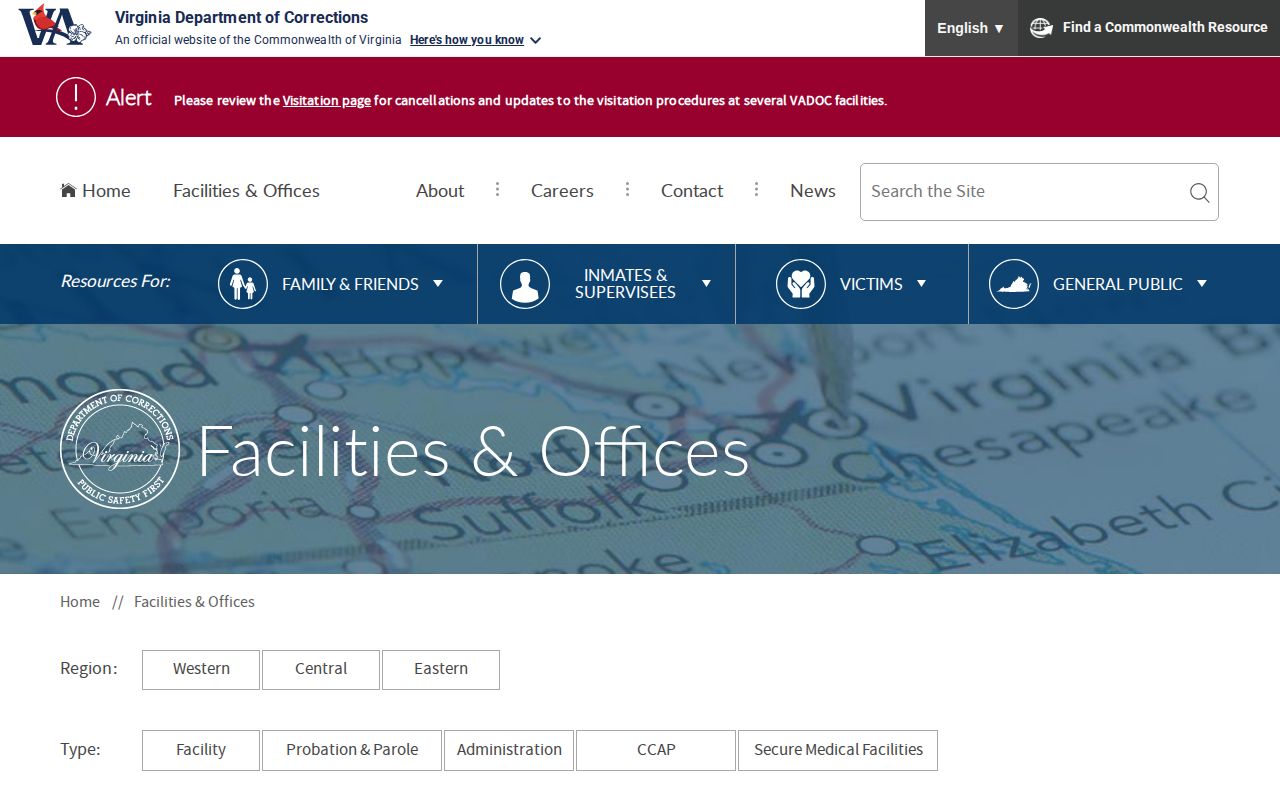
The active directory should be read beside the closure announcement so the two Haynesville institutions are not merged.
Richmond County Unit Record Boundaries
Sheriff Stephan B. Smith's Richmond County Sheriff's Office is not the custodian for Unit #17. The Northern Neck Regional Jail holds local and regional detainees, not the historical VADOC prison record. A person could move between legal systems, but each agency records only its own custody.
The Richmond County Circuit Court can provide a public sentencing or revocation order when the case belongs there. Court authority can explain a state term, while VADOC facility history and executed documents prove how the prison system carried it out.
Closure Evidence Prevents False Release
The VADOC closure announcement is the key local-history source. It identifies the closure and states that affected prisoners were moved according to classification and security level. That positive transfer statement outweighs an inference drawn only from the unit's disappearance from an active facility list.
For a careful conclusion, cite each agency narrowly: VADOC reports that Unit #17 closed and its population was relocated; the locator reports a later prison or supervision placement; an executed release record reports actual departure; a Board report records final parole discharge. When those sources differ, compare their dates and preserve the sequence rather than forcing them into one event.
Identity should also be tested across the chain. Compare the seven-digit DOC ID, full name, age, conviction locality, and facility dates before combining two records. A shared name or an old photograph cannot establish that the records belong to one person. If the identifiers remain uncertain, ask VADOC to route a precise facility-history request rather than state an unsupported release finding.
The most accurate final wording names the scope: VADOC moved the person from Unit #17, VADOC later released the person on the documented date, or the Parole Board later discharged supervision. Each statement answers a different question and avoids implying more than the official record shows.
Note: State the exact VADOC event and date instead of broadening a facility departure into unrestricted freedom.